The
EFTA/EU delegation of the Federal Assembly hosted this year’s interparliamentary meeting with the EU, which takes place alternately in Switzerland and in Brussels. At the meeting co-chaired by Damian Müller, member of the Council of States (FDP, LU) and chair of the EFTA–EU Delegation, and Norbert Lins, MEP (EPP, Germany) and chair of the DEEA, the parliamentarians discussed the current state of bilateral relations at the Lucerne Culture and Congress Centre (KKL).
The meeting focused on expressing appreciation for the new Switzerland–EU package (Bilateral Agreements III), which the Council of States debated as first chamber during the autumn session of Parliament (28 September–1 October) and on discussing the relevant parliamentary procedures relating to it. In this context, the chief negotiators for Switzerland and the EU, Patric Franzen (Deputy State Secretary at the FDFA) and Richard Szostak (Director at the Secretariat-General of the European Commission), outlined the results achieved in the negotiations. [Both sides commended the package as a strong compromise that promotes the interests of both the EU and Switzerland and serves as a basis for stable relations.] In addition, Council of States member Carlo Sommaruga and MEPs Christophe Grudler and Andreas Schieder discussed the ratification procedures in their respective parliaments. Once deliberations in the Council of States have been concluded – with the exception of the electricity agreement, which has not yet been considered – the dossier will be referred to the National Council where it is due to be debated in the winter session. The Council of States has also voted in favour of putting the package to a referendum before the people and the cantons; it is now the turn of the National Council to decide on the matter of a referendum. For its part, the European Parliament’s Committee on Foreign Affairs approved the package by a large majority in September. A vote in the European Parliament’s plenary session is now imminent. In the context of the Swiss process, MEPs emphasised the importance of considering the package as a whole. Views were also exchanged on the issues of immigration, internal security and the social welfare system. The Swiss delegation made their colleagues in the European Parliament aware that the parliamentary deliberations in Switzerland have to pay special attention to these areas to increase the level of acceptance of the package.
Another key topic of discussion was wage protection, a key element of the package for Switzerland. and its implementation in Swiss law. Jerôme Cosandey (SECO Deputy Director) explained the solutions reached in the agreements and in the implementing legislation. In addition, representatives of the Swiss social partners experssed their views: Pierre-Yves Maillard, member of the Council of States (president of the Swiss Trade Union Federation), Severin Moser (president of the Swiss Employers’ Association) and Nicole Hostettler (president of the Association of Swiss Labour Market Authorities, Canton of Basel-Stadt). Particular emphasis was placed on the strong social partnership in Switzerland and the importance of the jointly drafted wage protection measures.
In addition, the participants discussed the global challenges in the fields of geopolitics, trade and technology. Professor Cédric Dupont (Geneva Graduate Institute), together with representatives from the FDFA and the European Commission, analysed the responses of Switzerland and the EU to these developments with the focus on Europe’s role and ways of strengthening its competitiveness in these challenging geopolitical times. In this context, reference was made to the development of broad, horizontal EU regulations – such as the
Industrial Accelerator Act (IAA) – which may have a direct or indirect impact on Switzerland as a business location. A specific example of this dynamic was the EU steel measures, which those affected from the business community subsequently discussed with Members of Parliament during a round-table discussion. The Swiss delegation called for Switzerland to be regarded as part of a joint solution and highlighted Switzerland’s status as a strong centre for business and innovation. Both sides emphasised their shared values as a key component of the partnership.
The meeting concluded with a discussion on the future of parliamentary cooperation, specifically regarding the possible establishment of a Joint Parliamentary Committee (JPC). This is provided for in the Protocol on Parliamentary Cooperation between Switzerland and the EU of 2 March 2026 as part of the package. The Switzerland–EU JPC, which will have equal representation from both sides, is intended to place parliamentary oversight of bilateral relations on a new institutional footing by exercising rights to information vis-à-vis the executive branches and by making recommendations to the contracting parties.
The Swiss Federal Assembly was represented at the meeting by the delegation Chair Damian Müller (FDP, LU), Council of States members Carlo Sommaruga (SP, GE) and Hannes Germann (SVP, SH), and National Council members Elisabeth Schneider-Schneiter (The Centre, BL), Christine Badertscher (Greens, BE), Thomas Aeschi (SVP, ZG) and Hans-Peter Portmann (FDP, ZH).
On behalf of the European Parliament, the following MEPs took part: Norbert Lins (EPP, Germany), Andreas Schieder (S&D, Austria), Lukas Mandl (EPP, Austria), Jüri Ratas (EPP, Estonia), Mariateresa Vivaldini (ECR, Italy), Villy Søvndal (Greens, Denmark) and, via video conference, Christophe Grudler (Renew, France).
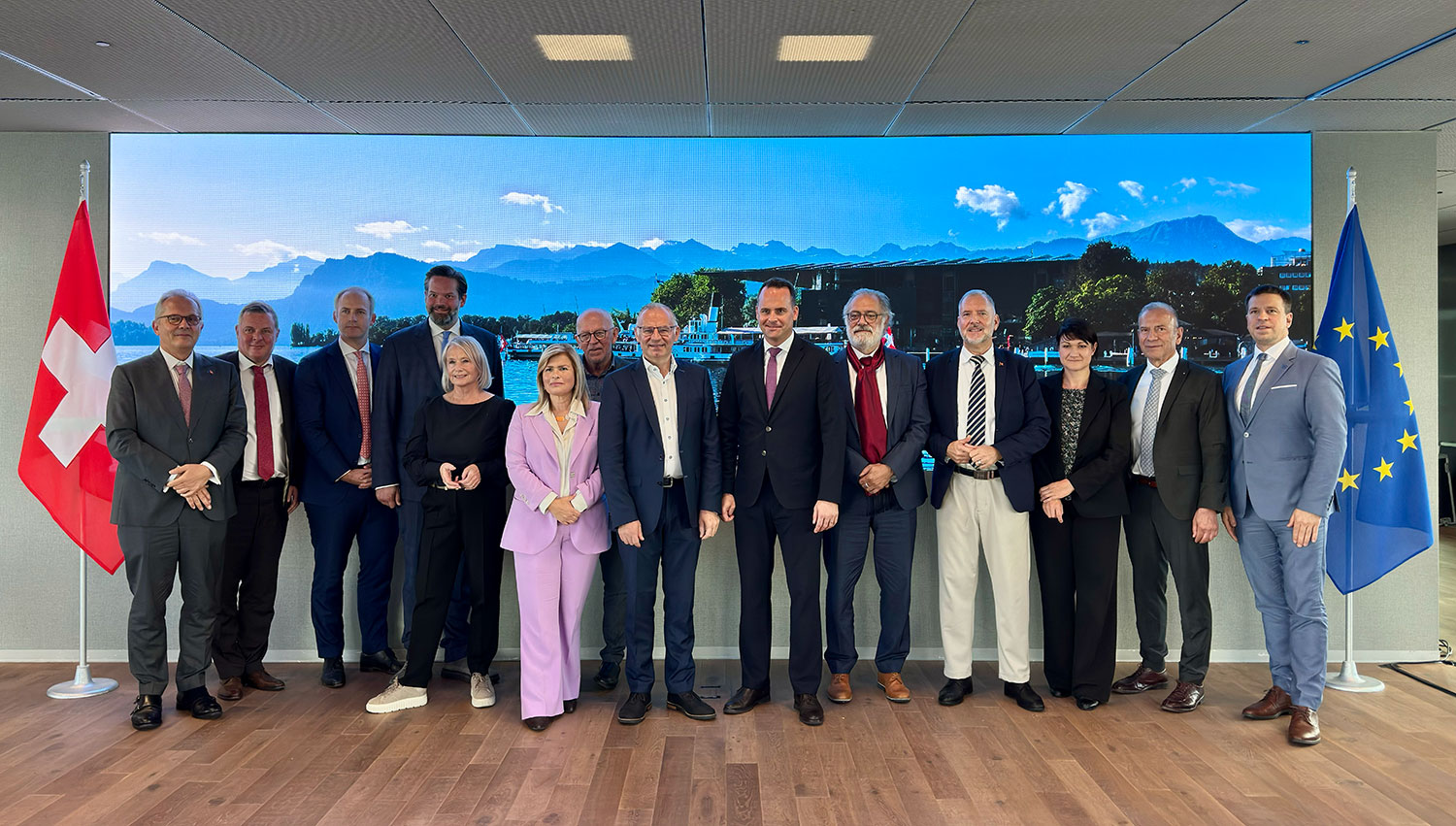
Group photo of the participants in the 45th Switzerland–EU Interparliamentary Meeting